
 Is Your Germantown Garage Door Worth Fixing, or Is It Time to Replace?
Germantown homes built mostly in the 1980s-90s face cold-weather wear on original doors.
BlogGermantown, MD · 4 min read
Weather Seals and Draughts in Germantown's 1980s and 90s Garage Doors
Germantown homes built mostly in the 1980s and 90s face cold-climate draughts and worn seals. Here's when to call, what's going on, and what to fix first.
Local detail
When to Get Help
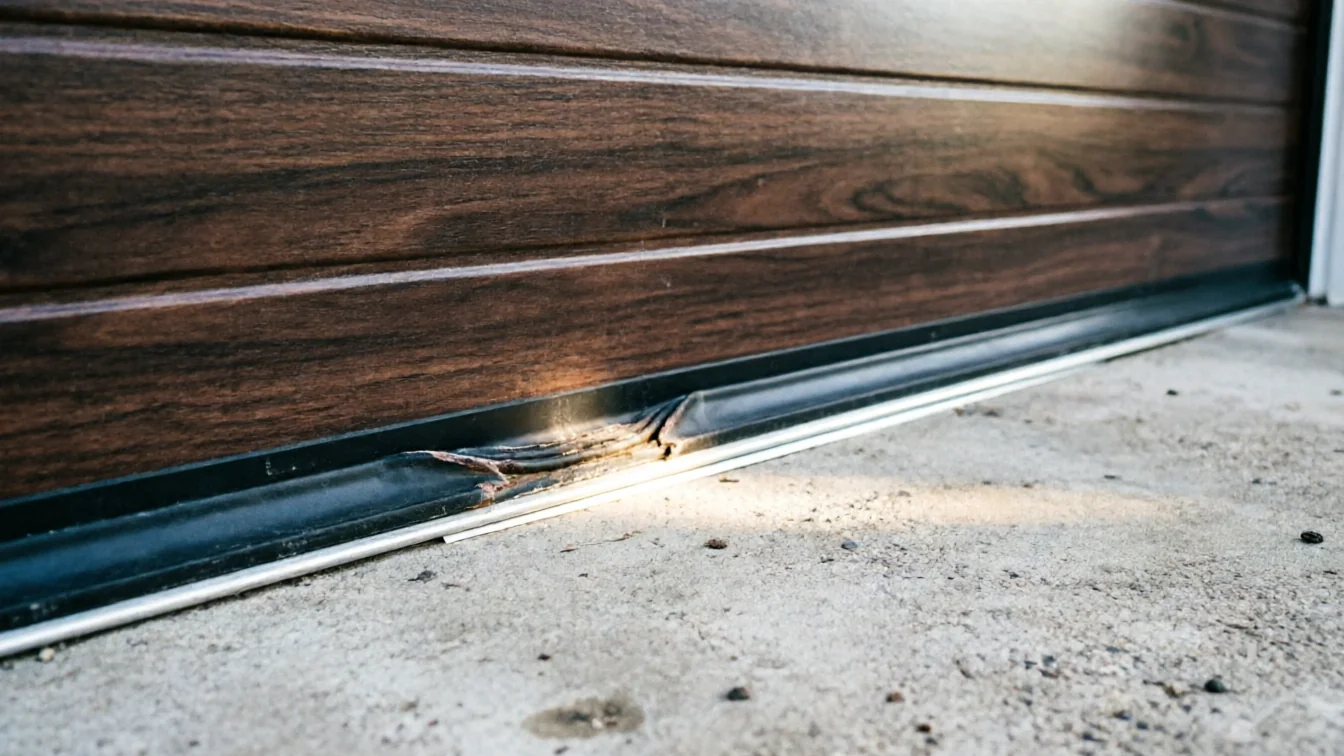
If you feel a cold draught along the bottom of the door or see daylight at the corners, that's your weather seal, not your opener. Call when the seal has cracked, pulled loose from the track, or gone stiff enough that it no longer flexes against the slab - in this cold-severe climate band, a seal that's lost its flex stops sealing the moment temperatures drop, which is most of the winter here. Also call if the door is noticeably heavier to lift by hand than it used to be, since that often means the seal is frozen to the concrete and tearing as it lifts. Don't wait until a pipe near the garage freezes to deal with it - that's a plumbing bill on top of a garage door bill. One honest limit: if the bottom bracket or track has rusted through from years of melting snow pooling against it, a new seal alone won't fix the draught. At that point you're looking at track or bracket replacement, and we'll tell you that up front instead of selling you a seal that won't hold.
The area
What Local Conditions Do
Housing across this service area was built mostly between 1951 and 2015, with the bulk of it - including most of the 45 named communities in this stretch, from Montgomery Village to Clarksburg - going up in the 1980s and 90s. That matters because the vinyl and rubber weather seals installed on doors from that era were never built for a 30-plus year service life, and the cold-severe climate band this area sits in accelerates the breakdown. Vinyl gets brittle in sustained cold, and once it loses elasticity it cracks rather than compresses, which is exactly when draughts start. Homes closer to the older end of that build range - 1980s construction - are now 40-plus years out from original install, which is well past any seal's working life regardless of brand. If your house falls in that window, the seal you have is almost certainly original or a single cheap replacement, and it's not doing the job anymore.
What we find
What Most People Get Wrong
The most common mistake we see is treating a draught as an opener problem - people adjust the travel limit or the force setting, thinking the door isn't closing all the way, when the door is closing fine and the seal just isn't making contact anymore. Adjusting the opener doesn't fix a flattened or torn seal; it just changes where the door stops, and can strain the springs if pushed too far. Another common one: buying a universal seal strip without checking the track width first, since a lot of 1980s-90s doors in this area use a track profile that's narrower than what's sold in most big-box seal kits. It looks like it fits, then peels off within a season. People also skip the corner seals and threshold entirely, sealing only the bottom edge, which still leaves the gap at the slab corners where the real cold air gets in.
How we work
What Is Going On
What's actually happening, mechanically, is simple: cold air finds any gap bigger than a few millimeters, and a compressed, aged seal creates exactly that gap along the bottom and sides of the door. In a climate band classified as cold-severe, that gap isn't an occasional nuisance - it's a near-constant path for outside air into an attached garage, which then affects anything stored against the shared wall and any room above it. Given that most of the housing stock here dates to the 1980s and 90s, a large share of doors in this area are carrying original or long-overdue seals right now, which is why this comes up so often. The fix itself is usually straightforward - correct-profile seal, properly seated in the track, with attention to the corners - but it only holds if the track and bottom bracket underneath are still straight and rust-free.
Questions
Common questions
Why does my garage feel colder than it used to even though nothing's broken?
Nothing may be visibly broken, but weather seals harden and shrink with age, especially in a cold-severe climate. A seal that looked fine last winter can lose enough flex over one cold season to stop sealing properly, even with no tears you can see.
Can I just caulk the gaps instead of replacing the seal?
Caulk works on a fixed joint, not a moving door. The seal has to compress and release every time the door opens and closes, so caulking the gap will crack and fail within weeks. The seal needs to be a flexible strip, not a sealant.
My house was built in the late 1980s - is the seal probably original?
It's possible. Weather seals aren't built to last 35-plus years, so if no one's mentioned replacing it, you're likely on the original strip or a single past replacement that's also now worn out. Worth a look either way.
Recommendation
You Might Also Like
More garage door guides for Germantown homeowners.
Is Your Germantown Garage Door Worth Fixing, or Is It Time to Replace?
Germantown homes built mostly in the 1980s-90s face cold-weather wear on original doors.
 Garage Doors on Germantown Houses Built Before Insulation Rules Tightened
Germantown's housing stock runs 1951-2015, median 1984, mostly 1980s-90s builds that predate modern insulation codes.
 What a Germantown Technician Looks at Before Touching Your Door
Germantown homes mostly date 1951-2015, median build year 1984, in a severe-cold climate band.
Ready when you are
Need a garage door sorted in Germantown?
Germantown Garage Door Pros repairs and installs garage doors, springs and openers in Germantown, MD and the surrounding area.