
 Openers, Power Cuts, and the Germantown Housing Stock
Germantown's 1980s-90s housing stock and cold winters put real strain on garage door openers during power cuts.
BlogGermantown, MD · 4 min read
Why Safety Sensors Drift on Germantown Garage Doors
Germantown's 1980s-90s housing stock and cold winters push garage door safety sensors out of alignment. Here's when it matters and when it's just a nuisance.
Local detail
When to Get Help
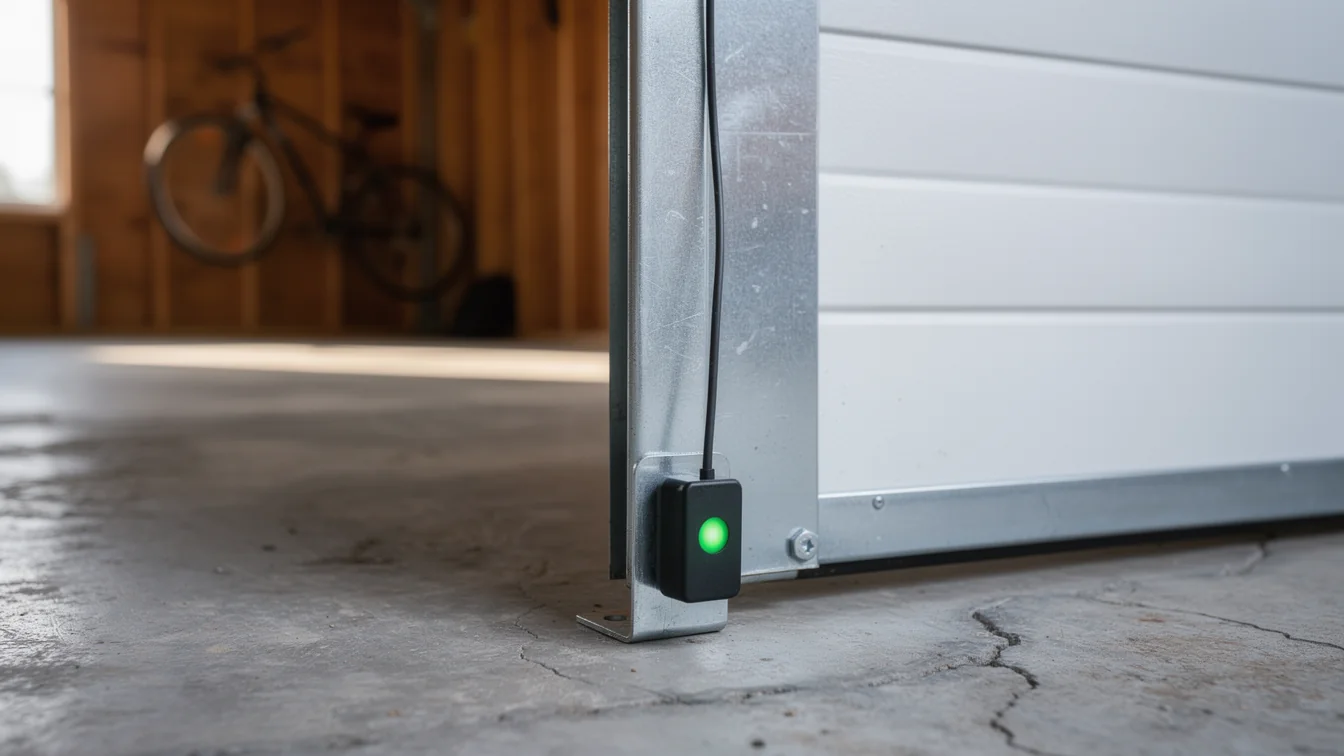
If your door reverses before it touches the floor, or the opener light blinks and the door won't close at all, that's the safety sensors telling you something. Don't ignore it and don't bypass it by holding the button down - that defeats the one part of the system built to keep a door from closing on a kid, a pet, or a bike.
Call if the sensors are clearly knocked out of line (one LED steady, one blinking or dark), if the eyes are coated in grime you can't wipe clean, or if the bracket itself is bent or loose on the track. Most of Germantown's garage doors sit on openers installed or retrofitted sometime after the 1993 federal sensor mandate, which means a lot of houses built in the 1951-2015 range - median year 1984 - have sensors that were added to an older setup rather than built in from day one. Those retrofit brackets are usually the first thing to work loose.
If the door won't close even with clean, aligned sensors, that's a different problem - likely the logic board or the opener itself - and worth a separate call rather than more fiddling with the eyes.
The area
What Local Conditions Do
Germantown sits in a cold, severe climate band, and that matters more for sensors than people expect. The brackets holding the sensor eyes are usually thin stamped metal, bolted or clipped to the track about six inches off the slab. Through a winter of hard freezes and spring thaw cycles, the concrete slab itself moves - not dramatically, but enough over years to tilt a bracket a few degrees. A few degrees is all it takes to throw the infrared beam off the opposite eye.
Houses from the 1980s-90s stock that makes up most of the area's 45 named neighborhoods often have garages on slabs poured decades ago, long before anyone was thinking about sensor alignment tolerances. The slab settles, the track shifts a hair, and the sensor pair that lined up fine in September starts blinking by February.
Condensation is the other piece. Cold nights followed by a warmer garage interior - especially if the garage shares a wall with living space, common in this housing era - fog the sensor lenses just enough to scatter the beam without an obvious sign anything's wrong.
What we find
What Most People Get Wrong
The most common mistake is assuming a blinking light means a broken sensor. Nine times out of ten it's alignment, not failure. People replace a perfectly good sensor pair when loosening two wing nuts and nudging the bracket back into line would have fixed it.
The second mistake is cleaning only the lens and skipping the bracket. If the bracket has shifted from slab movement - which, given how much of Germantown's housing dates to the 1951-2015 window with a lot of it mid-80s construction, is a real factor here - wiping the lens does nothing. The beam is still pointed at the wrong spot.
Third: people in older retrofit setups assume both sensors are the same age and quality. Often one was swapped out at some point and the other is original. A mismatched pair can look aligned to the eye but still miscommunicate.
And a limitation worth being honest about - if the bracket mount itself has rusted or the track it's clipped to is bent, realigning the sensor is a short-term fix. The track or bracket needs replacing, and no amount of adjusting will hold through the next freeze-thaw cycle.
How we work
What Is Going On
Two forces are working on your sensors at the same time in Germantown: age and cold. The age piece comes from the housing stock - median build year 1984, with most garages in this area built before sensor pairs were standard equipment, meaning the mounting hardware was often added later and isn't always as rigid as a factory setup. The cold piece comes from the climate band itself - severe winters move slabs, contract metal brackets, and build condensation inside a garage that's warmer than the air outside.
Neither of these causes is dramatic on its own. A slab shift of a sixteenth of an inch over ten winters doesn't sound like much. But sensors work on a straight-line infrared beam over a few feet, and that small a shift is enough to break the connection intermittently - working fine most days, failing on the coldest mornings when metal has contracted the most.
This is also why sensor problems in this area tend to show up seasonally rather than all at once. A door that closes fine all summer and starts acting up every January isn't coincidence - it's the slab and the bracket responding to the same freeze-thaw cycle, year after year.
Questions
Common questions
Why does my garage door only act up in winter?
Cold contracts the metal brackets holding your sensors and can shift the garage slab slightly after repeated freeze-thaw cycles. A beam alignment that's fine in summer can be off by enough in January to trigger a false reversal. It's one of the most common seasonal complaints we hear in this climate.
Can I fix sensor alignment myself?
Often yes. Loosen the wing nuts on each bracket, make sure both sensor eyes face each other at the same height, and check that the LEDs go solid rather than blinking. If the bracket is bent or the track it's mounted to has shifted, that's a hardware fix beyond a quick adjustment.
My sensors look fine but the door still won't close - why?
If both LEDs are solid and the lenses are clean but the door still won't close, the problem probably isn't the sensors at all. It's more likely the logic board, the wiring between the sensor and opener, or the opener itself.
Recommendation
You Might Also Like
More garage door guides for Germantown homeowners.
Openers, Power Cuts, and the Germantown Housing Stock
Germantown's 1980s-90s housing stock and cold winters put real strain on garage door openers during power cuts.
 Garage Doors on Germantown Houses Built Before Insulation Rules Tightened
Germantown's housing stock runs 1951-2015, median 1984, mostly 1980s-90s builds that predate modern insulation codes.
 What a Service Call Covers in Germantown
A look at what a Germantown Garage Door Pros service call covers, tied to the area's 1980s housing stock and cold winters, not generic advice.
Ready when you are
Need a garage door sorted in Germantown?
Germantown Garage Door Pros repairs and installs garage doors, springs and openers in Germantown, MD and the surrounding area.